Riley Powell · 1 November 2026
Seasonal Fluctuations in Recirculation Zones Alter Nutrient Pathways Across Barrier Island Wetlands
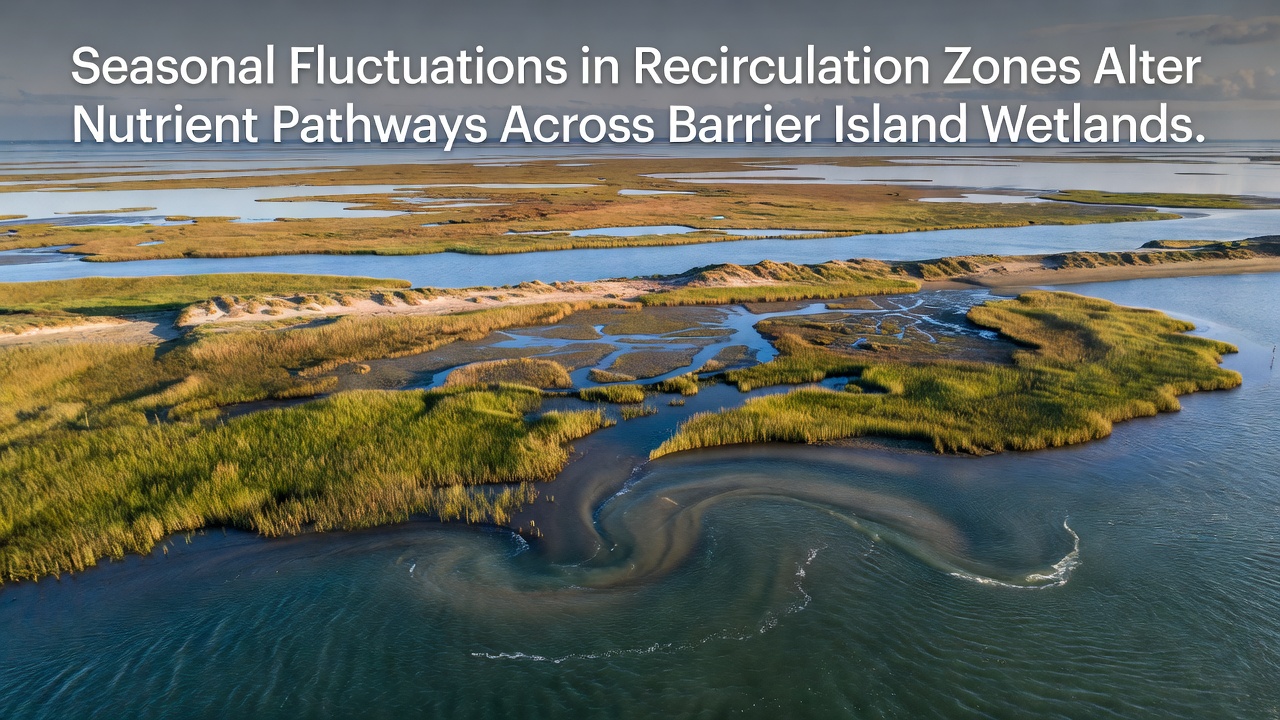
Barrier island wetlands depend on complex water movements where recirculation zones form temporary holding areas that trap and redistribute nutrients through tidal cycles and freshwater inflows. These zones shift with seasonal changes in water temperature, precipitation patterns, and wind-driven currents, which in turn redirect nitrogen, phosphorus, and organic matter across marsh surfaces and into adjacent estuaries. Researchers tracking these processes note that recirculation intensity peaks during warmer months when evapotranspiration rates rise and tidal amplitudes interact with altered salinity gradients.
Defining Recirculation Zones and Their Role
Recirculation zones develop where eddies and backflows create semi-enclosed water bodies behind dune ridges or within marsh channels, slowing exchange with the open ocean while allowing repeated contact between sediment and water column. Observers note that these areas function as nutrient processors because microbial communities break down organic material more efficiently when residence times extend. Data collected through November 2026 from multiple Atlantic and Gulf coast sites indicate that zone boundaries expand or contract by up to thirty percent between winter and summer, altering the volume of water that remains isolated long enough for denitrification and phosphorus sorption to occur.
Seasonal Factors Driving Zone Variability
Winter storms increase wave energy and push higher volumes of seawater across island platforms, compressing recirculation zones against interior marsh edges while diluting nutrient concentrations through rapid flushing. In contrast, spring and summer conditions bring reduced wave heights and increased solar heating that stratifies the water column, allowing zones to enlarge and retain nutrients longer. Precipitation events further modulate these patterns by delivering pulses of terrestrial nitrogen that enter the zones during low-tide periods before tidal return flows carry transformed compounds seaward.
Nutrient Pathway Alterations Observed
Pathways for dissolved nutrients change markedly once recirculation zones expand because longer residence times favor anaerobic processes that convert nitrate to nitrogen gas while binding phosphate to iron-rich sediments. When zones contract under stronger tidal forcing, stored nutrients release more rapidly into channels that connect directly to estuarine waters. Figures from long-term sensor networks reveal that ammonium concentrations inside active recirculation areas can reach three times the levels measured in adjacent open-water zones during peak summer months, yet export rates drop because the water remains trapped until the next major wind or tide event.
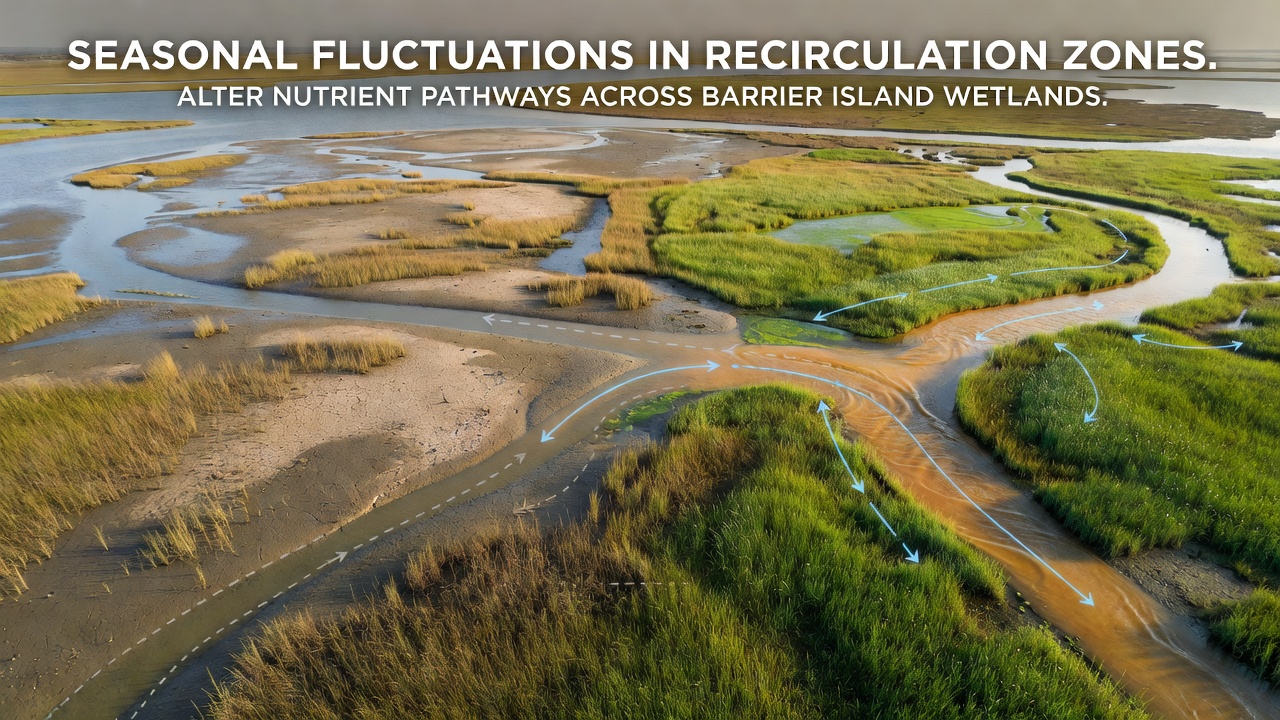
Those who've studied these systems over multiple years point out that organic carbon transport also follows seasonal routes tied to zone dynamics, with particulate matter settling inside enlarged summer zones before resuspension during autumn frontal passages. Such settling concentrates carbon in marsh soils that later support plant growth, while resuspension events export finer fractions that fuel plankton production offshore.
Field Measurements and Modeling Evidence
Monitoring programs operated by government agencies and university consortia have deployed current profilers, nutrient analyzers, and drone-based elevation surveys to quantify how recirculation zone geometry responds to seasonal forcing. Results show that a ten-degree rise in average water temperature correlates with a measurable increase in zone area because higher evaporation concentrates salinity and strengthens density-driven flows. Models calibrated with these observations predict that projected changes in storm frequency will further modify zone persistence, particularly on islands where inlet migration already alters tidal prism volumes.
One study released in 2025 used coupled hydrodynamic and biogeochemical simulations to trace individual nutrient parcels through barrier island systems, demonstrating that parcels entering recirculation zones during spring remain within the wetland complex an average of twelve additional days compared with parcels bypassing the zones entirely. Such extended residence directly increases the fraction of nitrogen removed through denitrification before water reaches the open estuary.
Broader Ecosystem Connections
Changes in nutrient pathways influence plant community composition because species such as Spartina alterniflora thrive where ammonium remains available during the growing season, whereas other marsh plants respond more strongly to phosphorus availability that fluctuates with zone contraction events. Bird and fish populations that rely on marsh productivity therefore experience indirect effects when seasonal zone behavior shifts the timing or location of nutrient delivery. Data from Australian coastal monitoring programs and Canadian wetland research stations confirm similar seasonal patterns, indicating that the underlying mechanisms operate across different climatic regimes.
Conclusion
Seasonal expansion and contraction of recirculation zones serve as primary controls on nutrient retention and export across barrier island wetlands, with measurable consequences for water quality, soil chemistry, and biological productivity. Continued collection of field data through programs such as those maintained by NOAA and comparable agencies in other regions will refine predictive models that forecast how future climate variability may reshape these pathways. Understanding the timing and magnitude of these fluctuations provides the foundation for evaluating long-term wetland resilience under changing environmental conditions.