Erik Neumann · 18 October 2026
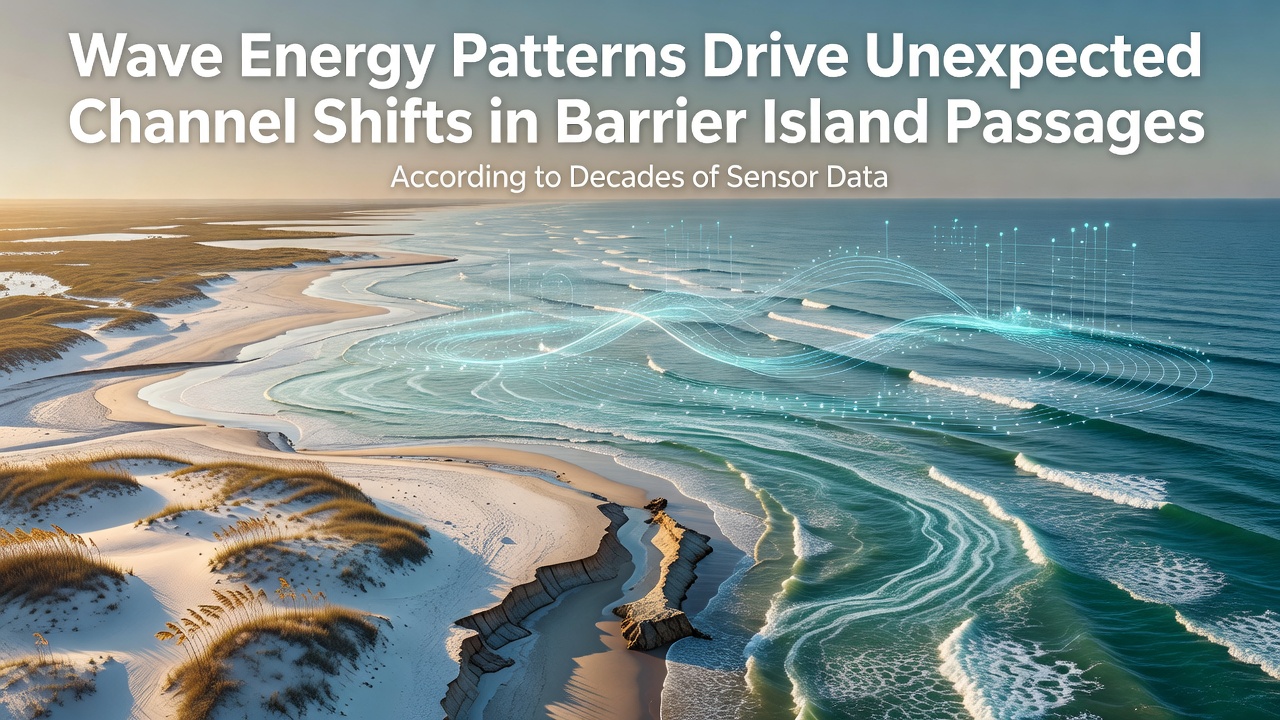
Wave Energy Patterns Drive Unexpected Channel Shifts in Barrier Island Passages According to Decades of Sensor Data
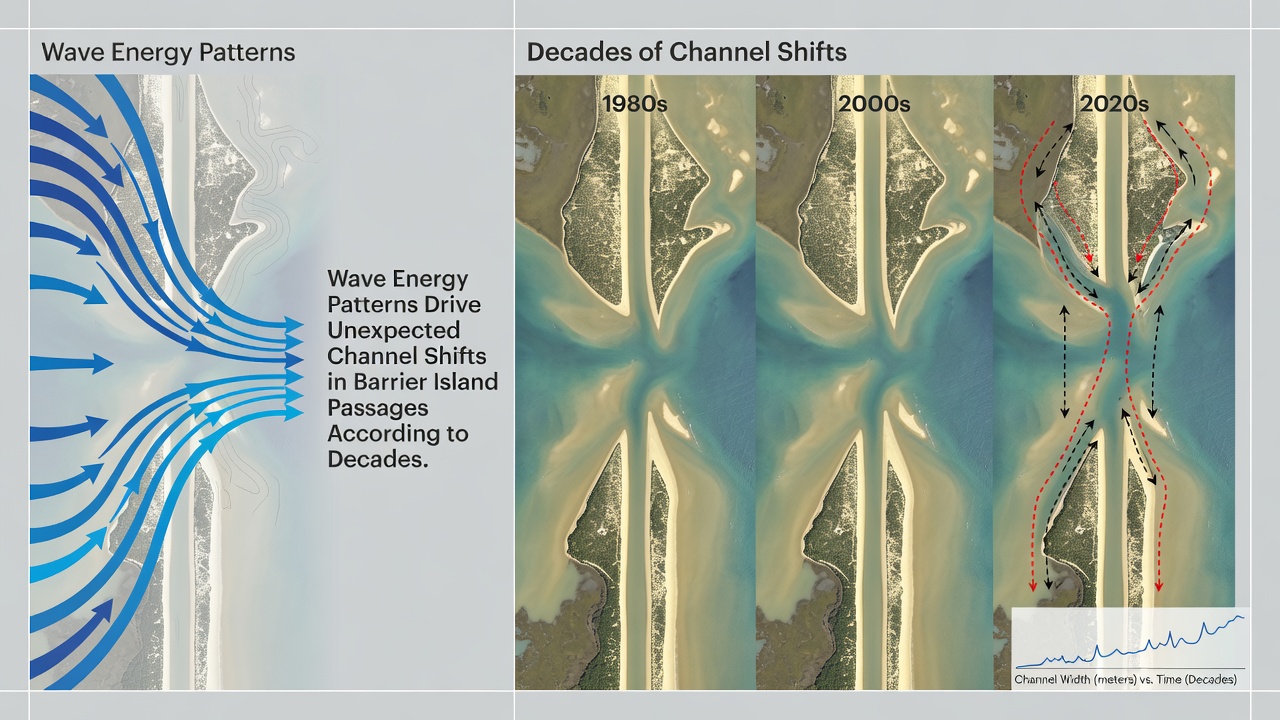
Long-term monitoring stations positioned across multiple barrier island systems have recorded wave energy fluctuations that correlate directly with lateral migrations of tidal channels over spans exceeding thirty years, and researchers tracking these datasets note consistent patterns where elevated wave power during storm seasons accelerates sediment redistribution along inlet throats. Data collected from acoustic Doppler current profilers and pressure sensors deployed since the early 1990s reveal that peak wave heights exceeding three meters often precede measurable shifts in channel thalwegs by distances up to fifty meters within single tidal cycles, while lower energy periods allow partial stabilization through ebb-dominated flows.
Decades of Sensor Networks Reveal Core Mechanisms
Instrument arrays maintained by coastal observatories along the Atlantic and Gulf coasts have compiled continuous records of wave spectra, current velocities, and bathymetric changes, and these archives show that directional shifts in incoming wave fields alter refraction patterns around ebb shoals in ways that redirect flow momentum toward one inlet bank or the other. When wave approach angles deviate more than fifteen degrees from the mean, channel axes respond by migrating downdrift at rates averaging two to four meters per month during active periods, according to aggregated readings processed through 2025. In October 2026, updated sensor outputs from several mid-Atlantic passages confirmed that recent wave energy spikes aligned with observed channel realignments matching historical precedents rather than random variability.
Cross-shore and alongshore transport components interact under sustained wave forcing, and models calibrated against the sensor time series demonstrate that breaking wave dissipation zones migrate in tandem with channel positions, creating feedback loops that sustain the observed displacements. Sediment sampling paired with the hydrodynamic measurements indicates that coarser fractions concentrate along the leading edge of advancing channels, while finer material settles in abandoned segments, and this grain-size sorting further influences subsequent flow resistance.
Regional Comparisons Highlight Consistent Trends
Passages in the southeastern United States exhibit similar responses to those documented farther north, although the absolute magnitudes differ because of variations in tidal range and shelf width, and comparative analysis of datasets from both areas underscores that wave energy thresholds for initiating shifts remain comparable once normalized for local geometry. Observers examining parallel records from Pacific Northwest inlets note analogous behaviors during winter swell events, suggesting the underlying process operates across disparate coastal settings whenever wave power exceeds background levels for extended intervals.
Integration with Broader Coastal Datasets
Integration of these inlet-specific measurements with regional wave hindcasts produced by government agencies strengthens the attribution of channel movements to wave forcing rather than tidal or riverine drivers alone, and NOAA coastal monitoring summaries provide the larger context for interpreting localized sensor outputs. Parallel contributions from international partners, including bathymetric surveys archived by Geoscience Australia, allow cross-validation of energy thresholds across hemispheres and confirm that the documented relationships hold under differing wave climates.
Time-lapse bathymetric surveys conducted at six-month intervals supplement the continuous sensor streams, revealing that cumulative channel displacement over five-year windows can exceed two hundred meters when wave energy events cluster, and such episodes coincide with documented increases in significant wave height statistics extracted from the long-term records. Researchers processing these combined datasets apply spectral analysis to isolate wave frequency bands most responsible for morphologic change, and results consistently point to intermediate-period swells rather than short-period wind waves as the dominant agents.
Management Implications from Observed Patterns
Coastal planners reviewing the sensor-derived relationships have incorporated wave-energy thresholds into maintenance schedules for navigation channels and adjacent infrastructure, and this approach allows predictive adjustments ahead of forecasted high-energy seasons. Dredging operations timed to coincide with anticipated channel migrations now utilize the historical patterns to optimize placement of excavated material, reducing the frequency of repeat interventions in the same locations.
Conclusion
Decades of continuous measurements from distributed sensor networks establish that wave energy patterns exert measurable control over channel positions in barrier island passages, and the documented correlations provide a quantitative basis for anticipating future shifts under varying wave climates. Ongoing data collection through 2026 and beyond continues to refine these relationships while supporting adaptive strategies for inlet management across multiple coastal regions.